Contents
Is professional photography worth it for a cheaper listing or a rental?
By the Duskpix team · Published 19 November 2026
For some listings, clearly yes. For many rentals and entry-level sales, the honest answer is that nobody has measured it, and the statistics you have been shown do not say what they are presented as saying. What the evidence does support is simpler: photo quality matters a great deal, and “professional” is one way to get it, not the only way. This page sets out what is actually known, what a photographer gives you that a phone cannot, and a way to decide listing by listing.
The short answer
- Book a photographer when the property has something a phone cannot capture: a view through a window, a large or dark interior, a facade that wants twilight, land that wants a drone, or a price where the fee is a rounding error.
- Shoot it yourself, and finish it properly, when the rooms are modest, the light is good, the turnaround matters more than the hero shot, or the listing is a rental that will be relisted again next year.
- Either way, the thing that moves enquiries is that the photos are bright, straight, honest and plentiful. That is the quality bar. Who holds the camera is a means to it.
What the evidence actually says
Almost every “professional photos sell faster” statistic on Australian photography websites traces back to one study, and it is American and twelve years old. In December 2013 Redfin compared homes priced between US$200,000 and US$1 million, listed and sold that year across 22 markets, by whether the listing photos were taken with a DSLR or a point-and-shoot camera. In the US$400,000 to US$499,999 band, the DSLR homes sold for an average of US$11,200 more and 21 days faster, and 64 per cent of them sold within six months against 46 per cent of the amateur-photographed ones. Above US$1 million the gap was four days. Homes with the sharpest 10 per cent of photos sold at or above list price 44 per cent of the time, against 13 per cent for average sharpness (Redfin, via PR Newswire).
Three things about that study matter for an Australian agent in 2026:
- It measured camera type in 2013, when a point-and-shoot was a poor camera. A current phone is not a point-and-shoot.
- The sharpness finding is the interesting one. It is about the photo, not the photographer.
- It is a correlation. Sellers who paid for photography in 2013 may also have paid for styling, better agents and better copy.
The other numbers you will see, “32 per cent faster”, “89 days against 123”, “118 per cent more views”, “61 per cent more views”, are repeated from site to site with Redfin or an unnamed portal as the source. We could not find any of them in the 2013 release or in any primary study. Treat them as marketing.
For rentals there is one Australian figure, and it is from 2015. Real Estate Business reported that rentals with dull or amateur photos listed over the previous month had been on the market for 22 days on average, while professionally photographed ones were leasing in as few as eight (Real Estate Business). The article does not describe the sample, and “as few as” is a best case, not an average. An Adelaide property manager describes one house that sat vacant 16 days without professional photos and leased in half that time when re-advertised with them (Toop). That is one house.
So: good photos matter, on the evidence; a hired photographer specifically has not been isolated as the cause in any study we can find. If you know of one, we would like to read it.
What a photographer adds
These are the things a phone and an edit do not replace, whatever the software:
- Bracketed exposures and flash. A room with a bright window and a dark corner is two photos blended, or a lit interior. Phone HDR closes part of that gap; a photographer closes it.
- The lens. A wide rectilinear lens on a full-frame body shows a small room without the stretched corners a phone’s ultra-wide produces. Our phone shooting tips cover how to work within it.
- Height, pole and drone. An elevated exterior, a straight-down block shot, a facade taken from across the road at the right moment.
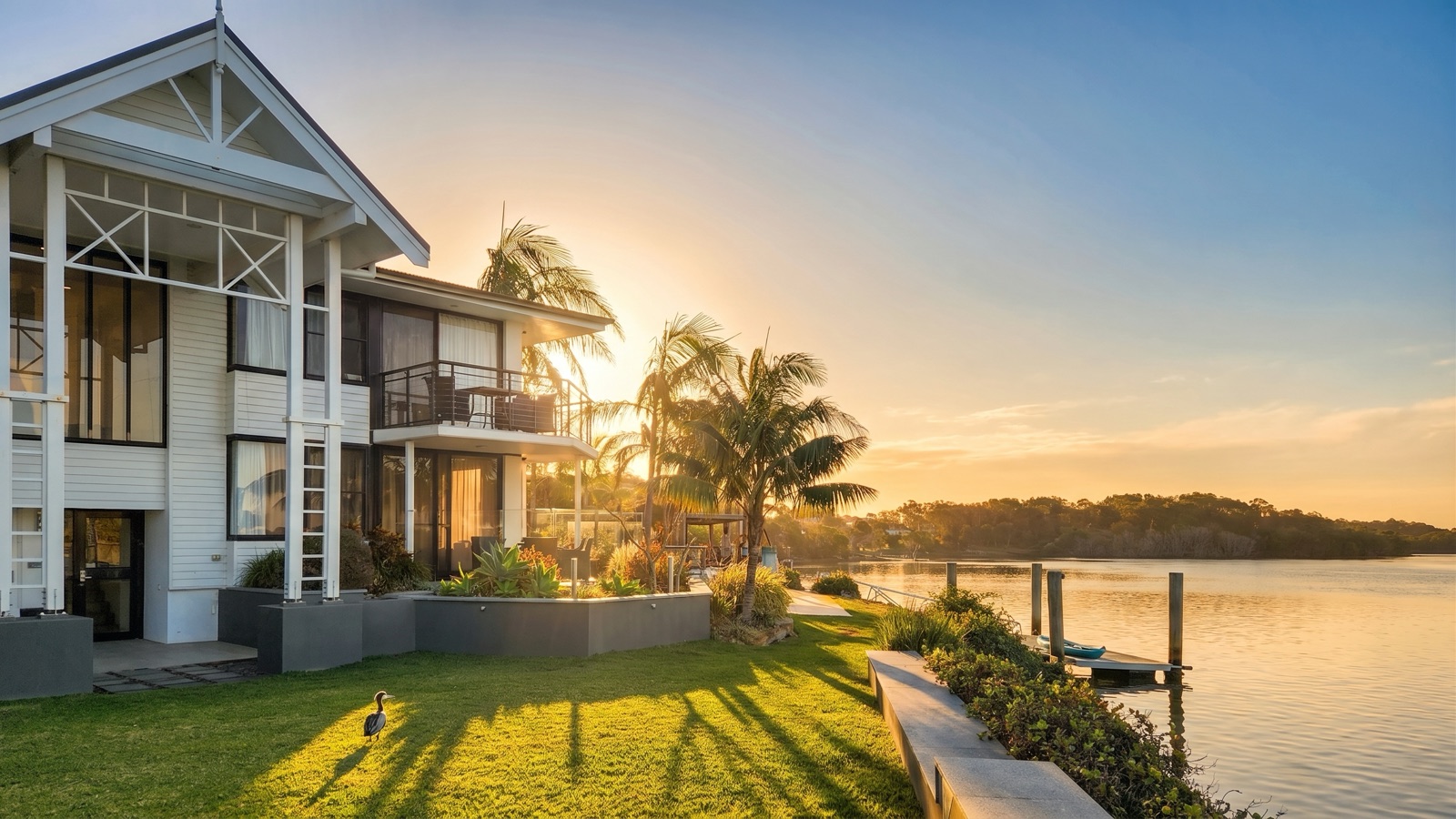
- Twilight on site. A real dusk shoot with the interior lit beats a conversion when the facade is the sale.
- Consistency and time. Twenty straight, level, evenly exposed frames in an hour, while you are doing something else.
When a phone and good finishing are enough
- Modest rooms with windows on one side and daylight at shoot time.
- Rentals, where the listing is reshot every tenancy and the enquiry comes from price and location first.
- Off-market, social and pre-launch material, where speed beats polish.
- Regional listings where the photographer’s travel loading is a large share of the fee.
- Any listing where the photos will be straightened, brightened and decluttered afterwards rather than published raw. The finishing is what closes the gap, and it is the step most phone shoots skip.
A decision table by listing
| Listing | Our call | Why |
|---|---|---|
| Rental relist, same condition as last year | Phone, finished | The photos will be reshot again; enquiry is led by rent and suburb. |
| Entry-level or mid-market sale, standard rooms | Either; phone if turnaround matters | The quality bar is reachable with care and finishing. A pro buys consistency. |
| Sale with a view, water or a dark large interior | Photographer | Window exposure and lens width are the whole photo. |
| Prestige, architect-designed, or a facade that sells at dusk | Photographer, with twilight | The fee is small against the price and the buyer expects it. |
| Acreage, large block, boundary matters | Photographer with drone, or a drone operator | A phone cannot show the land. See our boundary guide. |
| Off-market, social teaser, coming soon | Phone, finished | Speed and volume beat polish; the campaign shoot comes later. |
The money
A standard daytime package for a three or four bedroom house in a capital city is published at roughly $250 to $450, before twilight, drone or floor plans; our cost guide lists the figures by city with sources. On a $900,000 sale that is a rounding error against the commission. On a rental at $600 a week, relisted every year, it is a week’s rent each time, and the owner notices. The decision is rarely about whether photography pays; it is about whether this listing is one where the photographer’s specific advantages apply.
Where Duskpix fits
Duskpix is the finishing step, for a phone shoot or a photographer’s files. It straightens, brightens, declutters, stages and converts to dusk, and holds the walls, windows and fittings as shot. It does not add a window view that was blown out, widen a lens, or fly a drone. Where the lens or the light is the problem, book the photographer and finish their files here; where it is not, shoot it on the phone and let the finishing do the work (see rentals).
Shoot it yourself. Finish it properly.
Start with 50 free edits on your own listings, with no card required.
Claim your 50 free edits